Why the Meaning of Numerology Isn’t a Strange Coincidence
Do you notice the same number showing up over and over again? Maybe it’s on the clock, your grocery receipt, or on random license plates? It starts feeling a bit too specific to be a coincidence.
That’s when Numerology enters the chat.
Numbers are believed to be how the Universe, angels, ancestors, and/or our spirit guides speak to us. Each number has its own energy, frequency, and vibration, similar to crystals and colors. They carry spiritual meanings and help provide insight into your life, patterns, and the direction you’re heading.
Posts on this site may contain affiliate links that allow me to earn a small commission from your purchases (at no extra cost to you!)
Table of Contents
What is Numerology?
What if there was a purpose behind the patterns you keep seeing in numbers?
Numerology is the idea that numbers have a spiritual meaning and vibrate at a specific frequency. It’s not necessarily predicting the future, but more about aligning us with our purpose.
Every number has a connection to particular characteristics, themes, and patterns. It aids in our understanding of who we are, our life path, and the world around us. They’re a tool the universe uses to communicate ideas and feelings to us in our material world.
The Universe originates from complex mathematics strongly connected with Nature, when we can see it in patterns and shapes found in various places, including sunflowers, seashells, the cosmos, and even our DNA!
Watch: The Peculiar Brunette Explains Numerology for Beginners

Numerology Chart (How to Calculate Your Number)
Let’s make this as simple as possible.
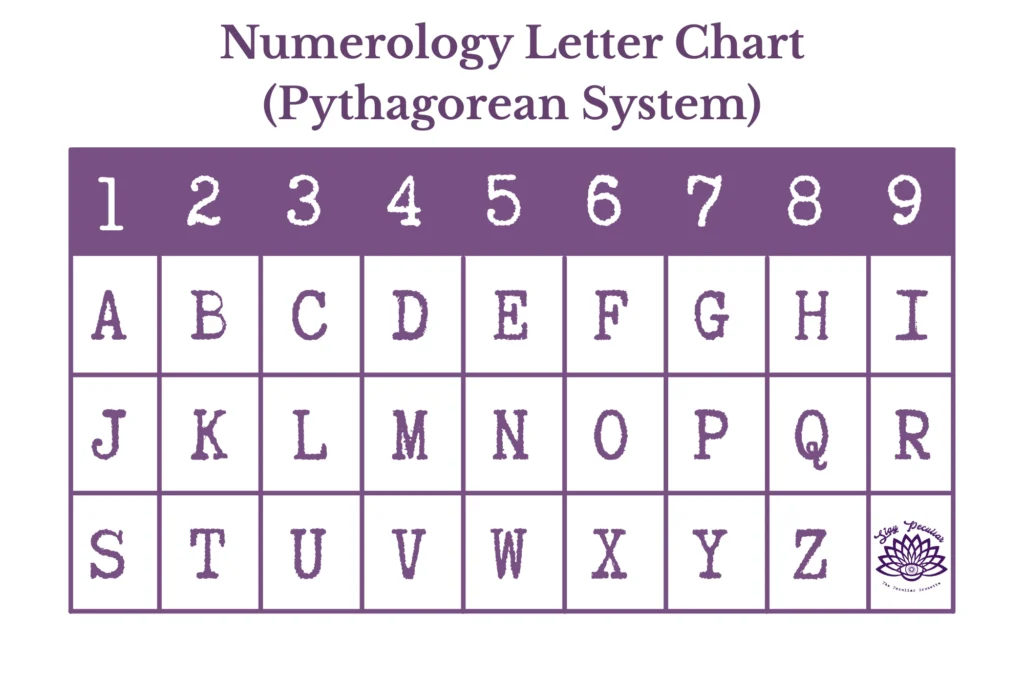
Numerology assigns numbers to letters using a chart. After adding them up and simplifying the outcome, you will have a single number reflecting your spiritual energy.
You can use the Numerology chart below to find the spiritual meaning of ANY words or letters in your life.
What is my Numerology Number?
Okay, let’s calculate your Numerology Number! Take your name and match each letter to a number using the chart below. Then add them together.
For example, say your name is Aubrey; using the chart below, you would add 1+3+2+9+5+7, which equals 27. When a number reaches double digits, you add those together to form a single digit.
2+7 equals 9. Now, you would check the significance of the number 9 to determine your name’s spiritual meaning.
What are Angel Numbers?
In the last few decades, the term Angel Number has become a more commonly used phrase that works with the same beliefs and ideas of Numerology.
Angel numbers may sound new, but they aren’t. They use the same meanings as numerology. It may appear to be two separate ideas, but they’re actually part of the same system.
What is a Master Number?
Don’t let the name Master Number intimidate you; it’s simply a category within Numerology. Most of the time, numbers are reduced down to a single digit, but not Master Numbers.
You’ll typically come across them calculating your life path or name numbers. If your final result is 11, 22, 33, etc, you do not reduce it further.
Master Numbers are associated with more intense or layered meanings compared to the single-digit numbers.
Do Numbers Mean the Same for Everyone?
Numerology uses shared meanings for each number, but how they apply can vary from person to person. They aren’t always the same because they’re based on vibrational frequencies.
The same number may have a slightly different interpretation depending on personal experience, energy, mood, or personal experiences. This is why it’s not always a one-size-fits-all situation.
What is a Numerology Life Path Number?
A Life Path Number is calculated using your birthdate and is an important part of numerology. It’s used to recognize recurring characteristics, themes, and patterns appearing throughout your life.
It represents your experiences, what you’ve learned, and how you’d like to grow throughout life. Figuring out and understanding your Life Path Number is usually where people begin with numerology.
How Numerology Is Used Today
In modern times, numerology is commonly used as guidelines for interpreting patterns and personality traits. It is commonly used to examine personal recurring themes or patterns of behavior using birth dates, names, and number sequences.
It’s often used for introspection and self-discovery rather than predicting the future.
Explore Numerology Meanings
Popular Angel Number Meanings
- What Does 111 Mean?
- 222 Angel Number Meaning
- 333 Angel Number Meaning
- 444 Angel Number Meaning
- 555 Angel Number Meaning
- The Sinister Truth Behind 666
More Angel Numbers
- The Spiritual Power of 123
- 414 Angel Number Meaning
- The Magic of 727 Angel Number
- 848 Angel Number Meaning

The History of Numerology
Numerology is also known as arithmancy (pronounced a-rith-man-see), which is the study of numeric divination. While numerology appears in many cultures, most modern interpretations are based on the Pythagorean system.
Arithmomancy, also called arithmancy, from the Greek arithmos (“number”) and manteia (“divination”), was practiced by the ancient Greeks, Chaldeans, and Hebrews; its successor is numerology.
Britannica – Arithmomancy Symbolism
The Greek philosopher Pythagoras (570 – 490 BCE) is often cited as the Western creator of numbers’ mystical and sacred characteristics. He believed numerology (which he called the Science of Numbers) was for the magical people of the world, and those who appreciated it understood the soul’s journey.
Pythagoras believed numbers to be sacred for various reasons, including correspondences with musical harmony, sacred geometry, astronomy, architecture, and the mathematical proportions of pentagrams.
However, Pythagoras studied in Egypt for twenty years, and it’s believed to be the source of his ideas on numerology. Pythagoras created a chart system assigning numbers to the alphabet letters, and it is one of the most extensively used types of numerology today.
The ancient Babylonians observed the movements of the planets, recorded them as numbers, and used them to predict eclipses and other astronomical phenomena. The priesthood of ancient Egypt used numbers to predict the flooding of the Nile.
Britannica – Number Symbolism
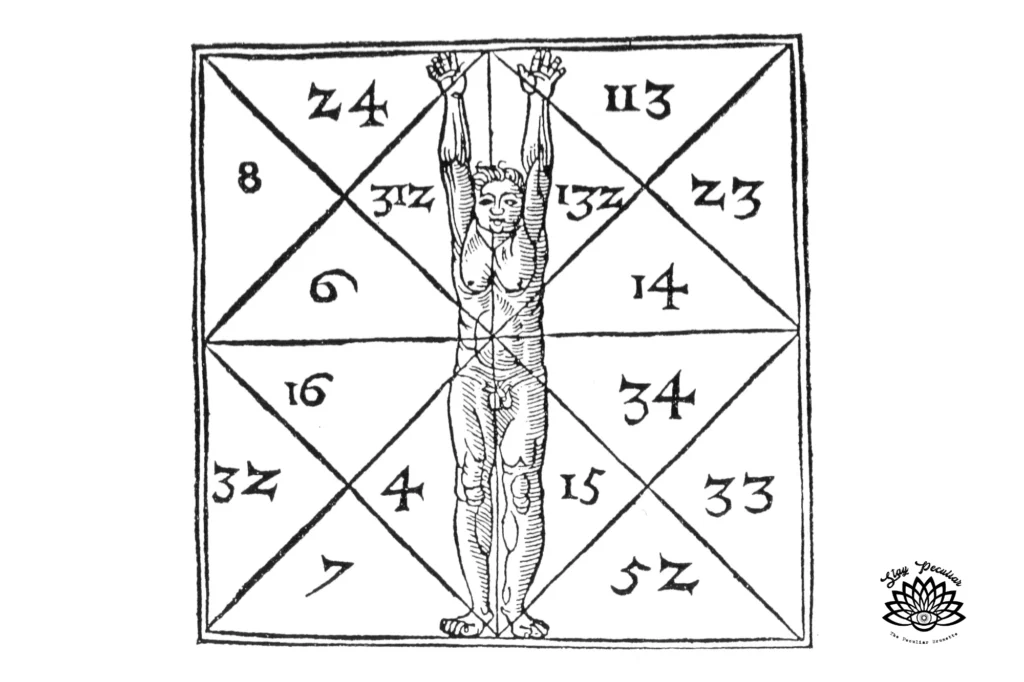
Heinrich Cornelius Agrippa (who you may remember from the Theban Alphabet article) also made a numerical chart based on the classic Latin alphabet and outlined it in Three Books of Occult Philosophy, but it’s rarely used in modern times.

Numerology From Around The World
Many other cultures found spiritual significance in numbers as well. For example, there is evidence of grooves etched into bones discovered in Zaire, Africa, believed to date to 9000 to 7500 BC (That’s about 11,000 years ago!!!). Each mark corresponds to the moon phases and is one of the oldest pieces of evidence of mathematical and spiritual interest.
You can also find numerology in ancient Chinese, Greek, Babylonian (Chaldean), and Hebrew philosophies and beliefs. Many other cultures would add or calculate specific number sequences, like the four digits of a year, to define characteristics and spiritual meaning.
In Fulani [a primarily Muslim people scattered throughout many parts of Africa sometimes known as Peul or Fulbe] tradition, numbers are the bait which attracts the mysterious…Thus one never mentions ‘the numbers of one’s children, cattle or wives, any more than one’s age, if one knows it.’
…The reason for this derives from animism. Like names, when numbers are uttered they release forces which start to flow like some underground stream, alive but unseen.
Dictionary of Symbols
Chinese Numerology
Chinese Numerology is a system of divination that believes each number holds a certain energy, and by analyzing the numbers in a person’s birth date or name, one can gain insight into their character, strengths, and weaknesses.
Traces of Chinese numerology can be found in the Yijing (also known as Zhou Yi or I-Ching in the Wade-Giles romanization). Ancient Chinese beliefs also include the He Tu and the Lo Shu grid (the 3×3 pattern was considered a perfect magical square).
The ancient Chinese saw numbers as something far beyond mere numerals; for them, numbers were alive and full of secrets. They symbolized the connection between the Heavens and Earth.
There are two kinds of numbers, odd and even. The ancient Chinese categorized odd numbers as yang and even numbers as yin. They regarded Heaven as yang, and therefore, they said, the odd numbers 1, 3, 5, 7, 9 represent Heaven.
They regarded Earth as yin, and therefore the even numbers 2, 4, 6, 8, 10 represent Earth. When the ten numbers are put together, they represent the natural phenomena in which yin and yang, Heaven and Earth, harmoniously complement each other.
Taoist Master Alfred Huang – The Numerology of the I Ching
Gematria
Gematria is a complex form of Hebrew numerology found in the Book of Raziel the Angel. Most historians believe this text was written in the 13th century by Jewish mystic Eleazer of Worms, who was referencing older writings.
The text says the angel Raziel showed Adam he could control his destiny through magic, whether through gematria or the cosmic energies activated by talismans. Each letter and glyph holds a profound meaning, allowing you to discover previously hidden connections.
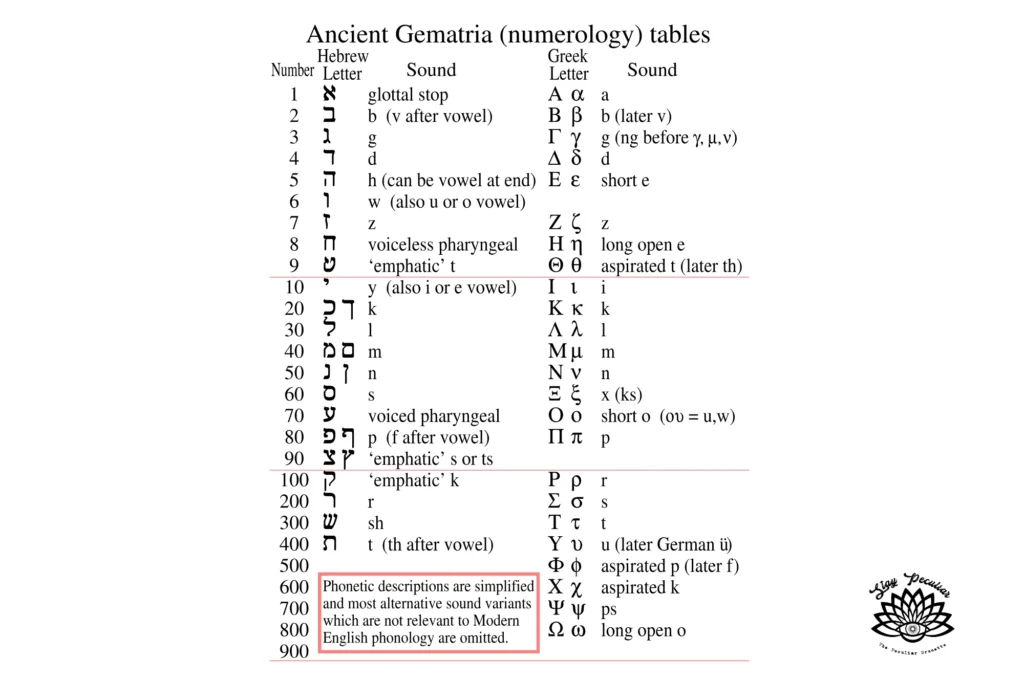
Each letter of the alphabet is deeply symbolic, both in the sound it makes and in its position in a word. The glyphs also have a numerical significance and one can reinterpret words by by adding the numerical values of the letters.
Signs and Symbols: An Illustrated Guide to Their Origins and Meanings
As you can see in the upper left of the graphic above, the glyph א represents aleph and the number 1. (Fun fact: this glyph is believed to originate from an Egyptian hieroglyph of an ox’s head).
Chaldean Numerology
In the sixth century BCE, magical practices (previously only passed on through oral traditions) began to appear in written Greek records.
According to the book A History of Magic, Witchcraft, and the Occult, “This was when ideas of magic were filtering westward from the Persian empire (and magicians were sometimes called Chaldeans, from a Persian province bordering Babylonia).”
From what I’ve read, Chaldean Numerology is completely different from the Pythagorean method. For example, the number 9 is rarely used because it’s sacred. However, I can’t find a reputable source discussing it in detail. If you know of one, please let me know!
[The Aztecs] also clothed numbers with cosmic significance. Each of them was associated with a particular god, colour, and point of the compass, as well as with a group of good or evil influences.
Dictionary of Symbols
Hindu Numerology
Hindu Numerology is called yantra. The numbers one through nine are seen as sacred, each with its own spiritual power and meaning. These numbers are believed to be a key to understanding the divine plan of creation and the relationship between the physical and spiritual realms.
Zero represents bhindu, the central point of the sri yantra, and as such is not used.
Bartlett, Sarah. The Secrets of the Universe in 100 Symbols
- Seed
- Germination
- Sprouting
- Testing
- Growth
- Budding
- Blossom
- Fruit
- Harvest
Final Thoughts on Numerology
At some point, the numbers either mean something… or they don’t. However, you wouldn’t be here if it felt completely random.
Numerology isn’t about having all the answers. It’s about noticing patterns, questioning them, and deciding what they mean for you. Some people go deep into it, others just keep an eye on what shows up.
Either way, now you know how it works. What you do with it is entirely up to you!
I hope this post on Numerology Meanings was helpful! Sending you lots of love and remember, as always…

Sources
Ducie, Sonia. #What is Numerology? Watkins Media Limited. 2016
Bartlett, Sarah. The Secrets of the Universe in 100 Symbols. Fair Winds Press. 2015.
A History of Magic, Witchcraft, and the Occult. Penguin Random House. 2020
Skinner, Stephen. Sacred Geometry: Deciphering the Code. Sterling Publishing Co., Inc. 2006
Signs and Symbols: An Illustrated Guide to Their Origins and Meanings. Penguin Random House. 2019.
Stewart, Ian. “Number symbolism”. Encyclopedia Britannica, 4 Nov. 2020, https://www.britannica.com/topic/number-symbolism.
Agrippa, Henry Cornelius. “Three books of occult philosophy” – PDF sourced from the University of Michigan Library online
Huang, Taoist Master Alfred. The Numerology of the I Ching: A Sourcebook of Symbols, Structures, and Traditional Wisdom. Inner Traditions. 1 July 2000.
The Penguin Dictionary of Symbols. Penguin Books. 1 March 1997.